
Cook Children's Steps Up for National Research Initiative
By Jean Yaeger
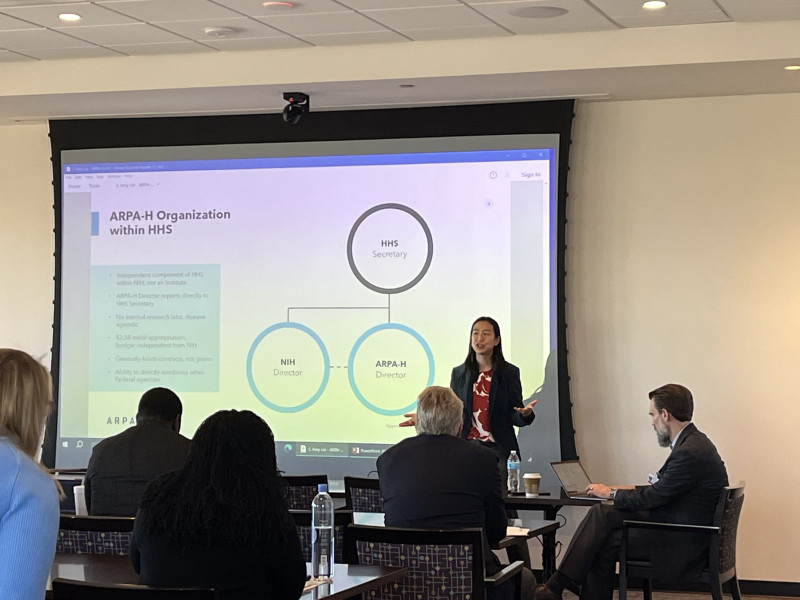
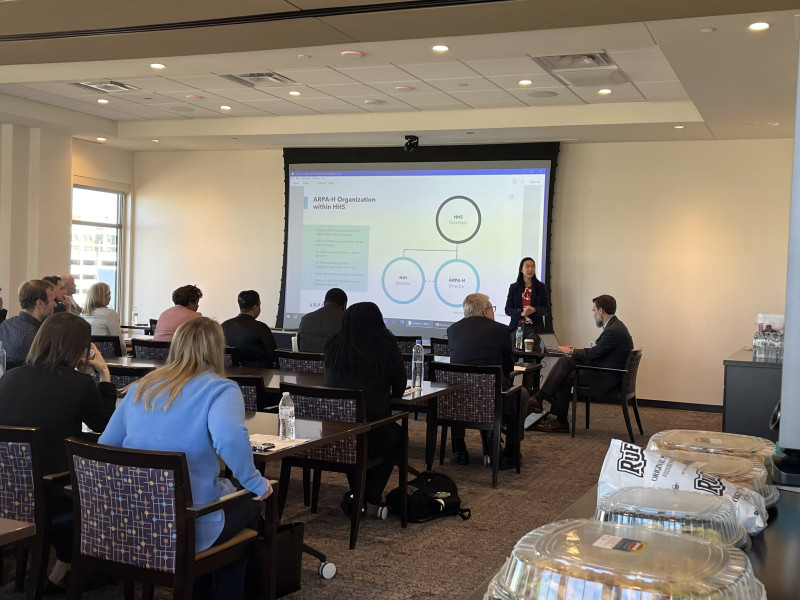
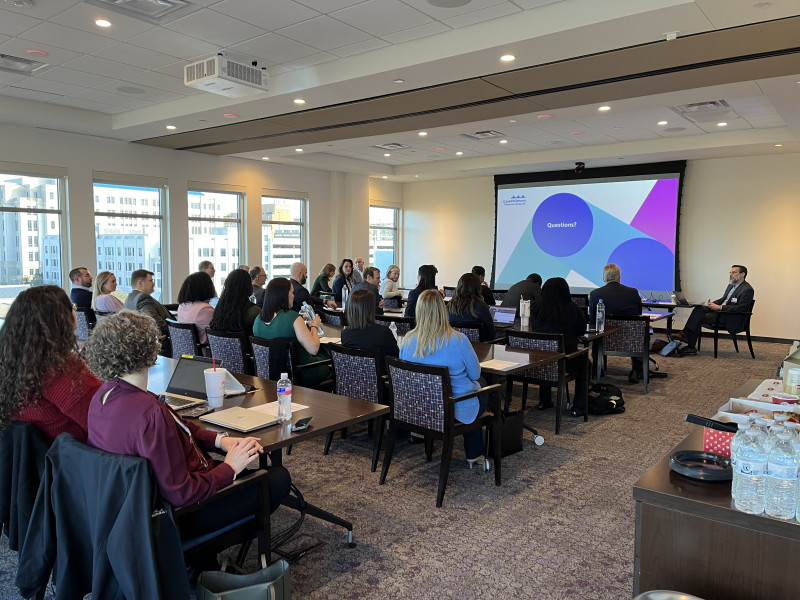
A site visit hosted by Cook Children’s connected our staff and local research partners with a new federal funding agency created to drive innovation in health care.
That meeting at Cook Children’s in Fort Worth attracted collaborators from the region as well as representatives from the Advanced Research Projects Agency for Health (ARPA-H). Cook Children’s is a “spoke” in the ARPA-H strategy for quick access to contracts that finance clinical trials, prototypes and other groundbreaking work.
Laurie Bailey, Ph.D., CCRP is director of Research Data Science & Analytics at Cook Children's. Laurie said ARPA-H opens the door to new opportunities and partnerships.
“By participating as a spoke, Cook Children’s has a voice at the table and can work with other innovators and institutions to develop and evaluate life-changing health solutions to improve the lives of the children and adolescents in our community and throughout the nation,” she said.
What exactly is ARPA-H and how does it work? A few key points:
- Created in 2022 by federal law as part of the U.S. Department of Health and Human Services
- Funding of $1.5 billion appropriated in 2024
- Uses a model of hubs and networks to link up health care providers, patient groups, academic institutions, industry and private investors
- Designed to move quickly from project approval to contract, with the goal of tackling the biggest challenges in health care by streamlining the access to research dollars
 “The idea is go fast, go big, spread money to sites and local institutions. Have the smartest people work on it, and then share everything,” said William Stigall, M.D., Chief Research Officer at Cook Children’s. “They’re not funding iterative improvements. They’re funding things that change the game. But it’s risky. Only the government has the kind of resources to mitigate this kind of risk.”
Dr. Stigall said Cook Children’s is well positioned to participate in ARPA-H due to our large catchment of patients in the growing Metroplex population. Another factor in our favor: The track record of research already being conducted here. Cook Children’s was home to 448 open studies involving 92 primary investigators and 14,144 subjects in 2023.
The Research Administration Office (RAO) at Cook Children’s spans eight divisions: oncology operations, general operations, investigator initiated, neurosciences, investigational drug services, regulatory affairs, research integration and research finance.
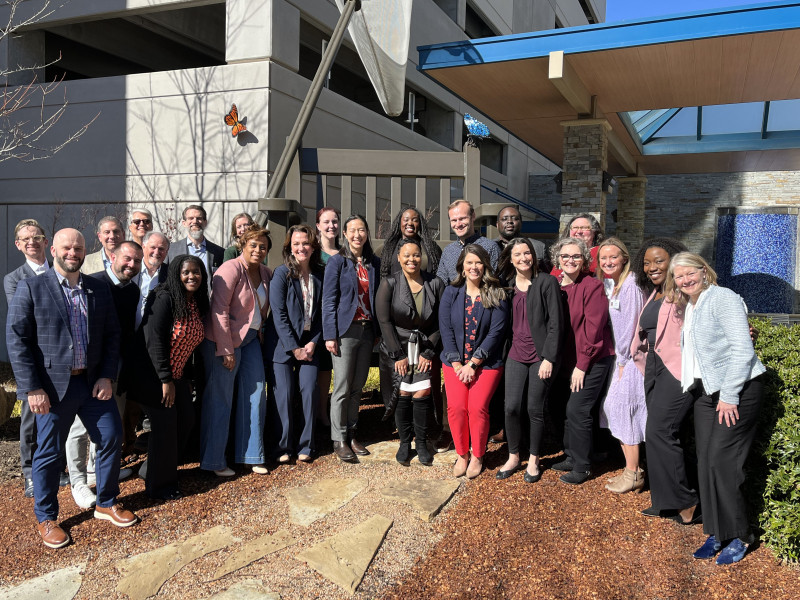
The site visit in February drew guests from Washington, D.C. and several states as well as our local collaborators, who include the University of Texas at Arlington, Texas Christian University Burnett School of Medicine, Texas A&M University School of Medicine, University of North Texas Health Science Center, JPS Health Network and DFB Pharmaceuticals Inc. Fort Worth Mayor Mattie Parker came too.
Representatives from Cook Children’s along with Dr. Stigall were Rick Merrill, president; Chris Pedigo, SVP, Chief Strategy, Education and Community Health Officer; and Matthew Dzurik, M.D., president of the Cook Children’s Physician Network.
Guests toured clinical areas including the Neonatal Intensive Care Unit, Pediatric Intensive Care Unit and the Jane and John Justin Institute for Mind Health. What they saw and heard – the abundance of research, beauty and imagination on our campus -- blew them away.
“It was nice to show off Cook Children’s and really show the volume of our patient population and that what we’re doing here is exciting,” said Alice Hoeft, supervisor for Research Data Science & Analytics.
Speaking of Spokes
ARPA-H got off the ground by establishing three hubs: a regulatory arm in Washington, D.C.; a venture capital arm in Boston; and a consumer experience arm in Dallas at Pegasus Park. Dr. Stigall said Dallas beat out Houston and cities in California in part because of the strength of the biotech industry in North Texas.
In December 2023 Cook Children’s became a spoke in the consumer experience hub. There are about 350 spokes right now, and only a handful of them specialize in children’s health.
“One of the major benefits of being a spoke is access to other institutions and other biotech companies, and getting our name out there and promoting Cook Children’s,” Alice said. “But also to have the project managers rely on us for guidance and to help shape the projects. We know pediatrics, and we know our patient population. What's really exciting about being a spoke is just having a seat at the table to really make an impact.”
Spokes that make up a hub network can build relationships with other consortium members. Their voices help shape the direction of research efforts.
ARPA-H is still trying to identify who the players are and who’s doing what in health research, Dr. Stigall said.
“We wanted to get us out in front by saying there are very few pediatric institutions that are our size and scope and have the research capabilities we do.,” he said. “Pediatrics is such a small population compared to the adult world, that getting out in front of this was super important. If you really want to fix things, fixing them in childhood gives you so much more bang for the buck.”
Hub agents who have a large project to award will solicit responses from institutions capable of taking on those projects. That’s where Cook Children’s comes in, Dr. Stigall said. Being so close to the Dallas hub is an advantage.
The site visit put research experts in the same room who needed to know about each other. In other words … Cook Children’s connected the dots.
Dr. Stigall comes from a background in bioethics and philosophy of medicine. He’s excited about the potential for research to solve – not just mitigate – diseases in children. He described ARPA-H as the health equivalent of implementing NASA.
“Research is tomorrow today, basically,” he said. “Most of the research we do here is clinical. It's directly affecting patients. When the standard of care doesn't work, or it palliates, through research you have the ability to offer something that patients won't be able to get through FDA-approved pathways for years, or they may not get it at all.”