Language Services Department Offers 200+ Languages to Empower Families
Taking your child to the hospital is usually stressful. And when you don’t speak the same language as the providers coming into the room, the experience can quickly become overwhelming.
The goal of the dedicated staff in Cook Children's Language Services Department is to ease that burden. The department provides interpretation and translation services for patients and guardians across the hospital system. Interpretation deals with the spoken language while translation converts written text.
But interpreters are not just a link between patient and provider; Cook Children’s interpreters provide empathy, connection and a sense of safety for families.
“We do it because it's the right thing to do,” Anylu NerioGarza, CHI-Spanish, LSSYB-L,, Director of the Language Services Department, said. “We need to involve our patients and our guardians in their care.”
Whenever a patient comes to Cook Children’s, their guardian(s) fill out a form where they can request language services. Most of the requests are for Spanish interpretation or translation and one of Cook Children’s 30 Spanish interpreters will meet with the family to ensure communication between them and their nurses and doctors.
In 2024, Spanish interpreters had 63,497 encounters with patients and families. Collectively, they spent a total of 717,931 minutes with families.
When Maria Garcia, CHI-Spanish, walks in a room to help a family, she can see the instant relief and gratitude on their faces. Maria, who has been at Cook Children’s for a year, said she and other interpreters provide empathy and comfort for people. Sometimes a child might already be acting as the interpreter between nurses and family members, and Garcia said it’s important to take that burden off the child.
She and Ramon AdameZambrano, CHI-Spanish, both experienced interpreting for their parents growing up and know it can be stressful. Ramon’s parents did not speak English, and when the family bought their first car when Ramon was 11, he helped them with the paperwork because they didn’t know what they were signing. He wants to ease children at Cook Children’s of that kind of responsibility.
“I’m able to help parents be at ease that they’re getting all the correct information,” he said. “But also allow that child that doesn’t feel well to just relax and heal. Because a lot of us were not granted this resource in our childhood.”
Ramon did not even know his current job existed until the family brought his brother to Cook Children’s after he broke his arm on the soccer field. Ramon’s now-manager helped his mom understand what was happening as providers prepped her son for surgery. The experience inspired him; he’s now been at Cook Children’s almost ten years.
He joined a growing team. Over the last few years, the need for language services has been amplified in the area, Ramon said.
Josefina (Josie) Rodriguez, CHI-Spanish, is the department’s most senior interpreter; she’s been at Cook Children’s for 30 years. In those decades, she has watched the department grow from two staff members to the community it is now. Those resources help interpreters juggle the various demands of their jobs; in each case, they have to understand the medical side of what’s happening, communicate the conversation and make sure they’re leaving space for the patient and family to ask questions. Through their role, they hope to also empower the patient and family to take an active role in their medical care.
Her favorite part of her job is building that relationship with families.
“It is important to build that trust. When you build that trust, that family will open up to you and will feel more comfortable asking questions,” Josie said.
 Most of the department’s services are used for Spanish-speakers, but Cook Children’s provides interpreters, translators and online resources in a multitude of languages. For example, the department frequently coordinates interpreters for people who need American Sign Language services. Cook Children’s second-most common language for interpreter services is Arabic, followed by Vietnamese.
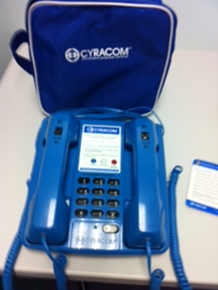
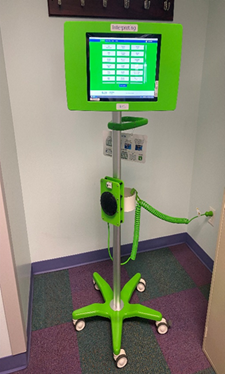 A network of contract interpreters are available to help patients and families over the phone or video. The Blue Phone, for example, is a literal phone set up in nurses’ stations across Cook Children’s that connects patients and families with interpreters in over 200 languages. The department also provides Green Carts, which is a table with an iPad or Surface Pro attached. Families can request to speak virtually with a Video Remote Interpreter (VRI) over video in 55 languages. If an interpreter is not immediately free, the Green Cart also has 200 audio interpreters. In 2024, patients at Cook Children’s spent more than one million collective minutes talking to VRIs.
Some interpreters, like Ramon, also provide translation for medical documents. This ensures that patients and families have access to information in a language they understand, especially on discharge paperwork.
Cook Children’s does not stop its language services at the door; Josie works with patients even after they leave the hospital to make sure that continuity of care is seamless.
Anylu has been with the system for 24 years and was an interpreter for the first ten. As a director, she sometimes misses the connection that comes from working directly with families. But the work can also be difficult.
As an interpreter, you may have to deliver serious news to a family and keep your own emotions in check, so you stay focused.
Anylu said the department is constantly adapting and innovating in order to provide patients and families with the best services possible — no matter what language they speak.
“We think about core values -- Like connection, elevation -- and we're not able to do those if we’re not providing interpreter services to our families,” she said.