
Nursing Spotlight: Rachel Duling and Kristen Jackson
 Rachel Duling, a clinical educator, and Kristen Jackson, a clinical nurse leader, recently traveled to West Africa to volunteer as nurses and deliver care to patients at a pediatric clinic called Sacre Coeur or “Sacred Heart.” Continue reading to learn more about their experience and possibly be inspired to take your nursing skills to new places.
What inspired our recent medical trip?
“There are times in your life when, if you listen closely, you find an opportunity to do hard things. Kristen said yes to Rachel’s awful sales pitch that claimed this trip would be a great way to give back and to see how the medical community thrives in different areas of the world, while sharing some of our medical knowledge for the greater good. Somehow, the part about this being a difficult trip or that Rachel was afraid this might be one of the hardest trips she had ever done was not disclosed (or was it?). All she heard was, “there is a need and we can help.”
What country did you travel to?
“We traveled to Guinea, West Africa to a town two hours outside of the Capital City, Conakry.”
Describe the location you were working in.
“We were working in a rural village, with this clinic being the only pediatric facility within hundreds of miles. In this area, 40% of the population is 15 years old and under, with a pediatric death rate of 1 out of 10 children. There are only 20 doctors in the country of Guinea, and the predominant languages spoken are French, Pular, Malinke, and Susu.”
Describe the Clinic you were working in.
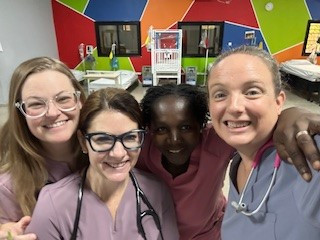 “The clinic was started by a few American and French doctors who saw a need in a country where healthcare was sparse to nonexistent. They created a clinic that provides primary care, emergency/ICU services, dentistry, nutrition coaching, and a pharmacy all in one building. They are teaching and empowering the Guinean people to provide care for their neighbors. They also run specialty clinic days for cardiac, sickle cell, and neurological care. These services are offered at a low cost to all patients, and they come from hundreds of miles away to be seen at the only pediatric clinic in the area. Hope Ignited’s dream is to establish a hospital in the next couple of years in Guinea.
What did your typical day look like?
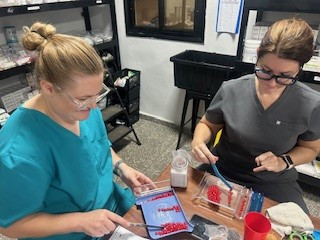
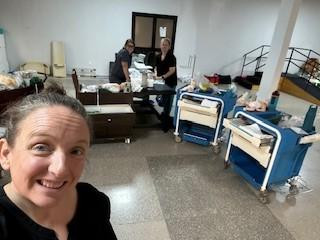
“Every morning, we prepped the Urgent Care/ICU area for the daily needs (mixing medications, making saline flushes, ensuring safety equipment was readily available at bedsides, making beds, restocking items as available, and ensuring laundry was cleaned, dried, and put away). Plans of care for returning patients were reviewed, and then the scheduled returning patients would arrive, along with walk-ups needing treatment. Patients were triaged, and the intake team would bring emergencies straight to the Urgent Care/ICU area from the gate when needed. Throughout the day, we collaborated and worked with doctors and other nurses to provide support with daily nursing tasks for patients with an array of diagnoses, which included patients with cardiac and renal disease, malaria, typhoid, meningitis, yellow fever, extreme dehydration, severe malnutrition, dysentery, seizures, cardiac events, respiratory failure/distress, burns, abscesses, and more. While providing care, we also utilized our skills in resource management to determine which items could be sterilized and repurposed for reuse. P.S. Don't tell joint commission.”
How did medical care differ from America?
“Nurses work with lack of or very limited resources (lab tests, electricity, medications (no narcotics) only a few portable oxygen tanks, imaging, diagnostic tools (labs, biopsies), medical supplies, lack of ability to consult with other physicians. Education received in nursing school is minimal in Guinea. They learn the very basics of nursing skills such as obtaining VS and administering medications. However, no teaching regarding critical thinking skills, reassessment skills, appropriate medication dosing limits, or the physiology behind disease processes.”
Can you share an impactful moment you experienced while caring for a patient?
 “It's hard to narrow it down to one experience- but the story of the little guy that lives in our hearts forever wins. Rachel had the pleasure of caring for a little 14-month-old boy during the last 4 days of our trip. He first came in with malaria and dysentery on Friday. We treated him and sent him home. He came back on Monday in very critical condition, and we could not figure out what was going on. We got a handle on one problem, and another one would arise, and everything we did, he kept getting worse. Rachel sat with him and his parents each day, giving care and comfort in any way she could.
Our hearts broke knowing that if we were in the States, we would have the resources to diagnose, treat, and his chance to live a healthy life would improve. However, we left that last day knowing he would soon be leaving this world. Many tears were cried on the way to the airport, out of feelings of defeat, failure, exhaustion, and grief. Rachel’s daughter face timed her at the airport asking if she was excited to be coming home. She broke down in the middle of the airport, crying in front of everyone (for those who know her, she does not cry in front of people). Rachel will never forget what her daughter said: "Mom, you did what you were called to do. You gave them love like they never would have known otherwise."
The nurses in us wanted to share a story about how we helped with some amazing procedures and saved so many lives, because is that not what a mission trip is about? But in truth, it isn’t about our skills or that we were anything special, it’s time you spend and love you give. That is a greatest gift you can give to every patient and family.”
What advice would you give to nurses considering going on a medical mission trip?
JUST DO IT!!!!