
Three Cook Children's Medical Professionals Receive Clover Award Recognition
 The Clover Award is named after Clover Harrold, a 9-month-old who died from sepsis. When the smiley baby girl got sick in 2017, her doctors and nurses did not identify the condition until it was too late. After Clover’s death, her parents -- both ER nurses -- became crusaders for quick recognition and treatment of a condition that can easily become deadly if people don’t know what to look out for. They developed the Clover Award, which is peer-nominated and highlights significant work on sepsis treatment in the medical world.
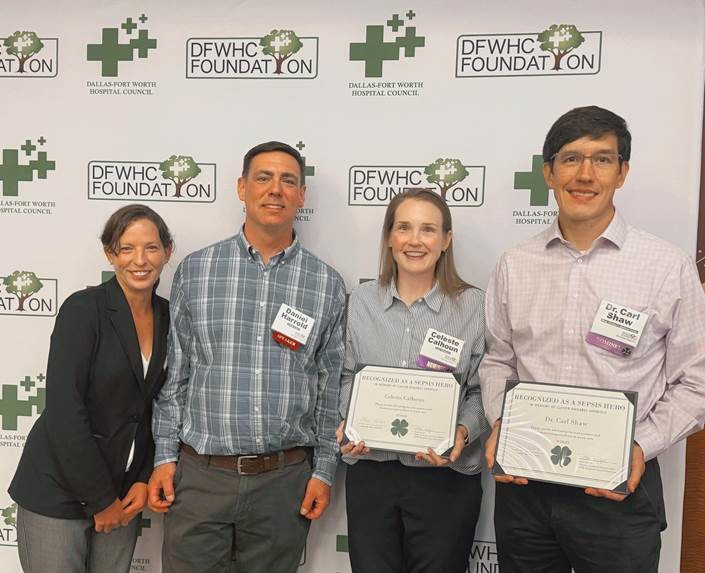
Five people in the DFW area received the award, three of them from Cook Children’s: Celeste Calhoun, RN, Carl Shaw, M.D., and Rachel Cress, BSN, RN. At the annual Sepsis Conference in September, Clover’s parents shared their daughter’s story and then presented the awards.
Celeste has been a member of the Sepsis Quality Committee since its inception in 2014. Shortly after the committee formed, Calhoun started educating staff in the Emergency Department about a sepsis tool -- developed by Javier Gelvez, M.D. -- that has made it easier to screen for children’s sepsis risk.
Calhoun has worked in the Emergency Department for 18 years – five of which as a charge nurse -- and knows how quickly children can deteriorate when they are septic. Sepsis is a systemic infection that can start from anything from a cut to appendicitis. It can lead to organ failure, the loss of extremities, and other serious complications. About 75,000 children develop sepsis each year; of those, about 7,000 die.
“If we can give them a fighting chance, that’s what I’m here for,” Celeste said.
The tool Celeste and her team created is a scoring system that flags for doctors and nurses when a child is showing signs of sepsis or at risk of developing it. The tool then prompts the appropriate treatment for those sepsis signs: fluids, antibiotics, oxygen, etc. At the Sepsis Conference, Clover’s parents met with Dr. Shaw and Celeste and went through the tool, noting all the ways in which the checklist would have caught Clover’s sepsis early on.
Beth Evans, chairwoman of the committee, nominated Celeste for the award. She said Celeste and Dr. Shaw, an Emergency Department Physician, have been instrumental in helping to standardize sepsis care.
Dr. Shaw was the first physician to join the Emergency Department’s Sepsis Quality Committee and helps champion the committee’s efforts. His work has shaped how Cook Children’s identifies, responds to and treats sepsis. Calhoun said for a long time, the committee did not have a physician on the committee and it was sometimes difficult to get doctors on board with changes they wanted to implement.
“He has been a great tool to have in our pocket,” Calhoun said.
Cheryl Petersen, Senior Vice President of Nursing and Chief Nursing Officer, said the sepsis scoring tool is one of the many ways Cook Children’s has improved sepsis practices over the years.
“When we have a tool like a checklist, it requires us to follow that in a logical order; we are driven to ask key questions, follow steps and perform interventions. And that is what makes the difference,” she said.
Recognition and treatment of sepsis has been a topic that Cook Children’s has committed to studying and creating solutions for many years, she said.
Rachel, an education coordinator in the PICU, has been a key part of system-wide education in identifying and treating sepsis. In October 2024, she started a project to improve the algorithm for sepsis-related signs and risks specifically. One of the challenges, she said, was making sure the system worked across all the floors. The Pediatric ICU, for example, has a different workflow than the Emergency Department.
The old algorithm started out as a simple score on EPIC, Rachel said, and the team adjusted and honed it to be more precise. Certain clinical signs, like decreased urine output, hypothermia, and fever, will prompt EPIC to give nurses and doctors a new sepsis section, “Stop Sepsis in Five.” EPIC will ask specific questions about the patient’s condition and help staff identify and intervene sooner. The new system is more streamlined, more sensitive to sepsis signs and swifter to identify sepsis.
A team of people collaborated to make the new system possible, Rachel said, including: Leigh Anne Campbell ,RN, a 4P EMU Education Coordinator who created the Med/Surg Sepsis ULearn activity; Dr. Gelvez, PICU Intensivist, a passionate and steadfast sepsis treatment champion; and Stephanie Lavin, Quality Coordinator, who works on all things sepsis.
Cress also emphasized the team of people who worked on the sepsis tool on the technology side:
● Tim Farris, Epic Clinical Systems Analyst
● Stacey Bancroft, Manager of Clinical Education
● Charles Mills, Media Production Specialist
● Cammie Larson, PICU Clinical Nurse Leader
● Kennedy Norman, Epic Clinical Systems Analyst
“It’s my constant goal to prioritize patient care and make it better for our patients. Our mission statement is ‘everything for the child’ and even if I’m not bedside anymore, it still means a lot to me,” Rachel said.
Receiving the Clover Award validated all the work the team did, Rachel said. Attending the conference also introduced her to the work other departments, like Celeste’s, are doing on the sepsis front. She wants to use this momentum as a jumping off point to keep improving sepsis early intervention.
To have staff be honored with the Clover Award is remarkable, Cheryl said, and a validation of the great strides the system has made in its practices surrounding the recognition and treatment of sepsis.