
Should We Have Coaches?
 Watching the Paris Summer Olympics with my family this year, I was reminded of this important but often overlooked topic in healthcare. If you name any athlete in any sport performing at the top of their game, you’ll often find they have not one, but multiple coaches. As physicians, are we not also like athletes trying to excel and improve in our “sport” each day?
Once we become an attending, there is an unspoken rule that we are now magically fit to practice independently in all regards. In medicine however, we’ve committed ourselves to a career that includes life-long learning and improvement; our learning doesn’t stop once training is over. Moreover, we are periodically tested on our clinical knowledge and technical skills in order to maintain board certifications and competencies, but we are often never provided real-time feedback on our “softer” skills like leadership or communication (both patient facing and interprofessional). Should coaching then be a natural part of our career?
It turns out that the data shows, it most definitely should. Many physicians have experienced positive results from coaching and not only in situations where perhaps coaching was used as remediation or for poor performance (which shouldn’t be the motivation; it should be proactive). Multiple studies have shown that coaching can help with burnout and positively impact physician well-being1,2. Coaching has even become part of medical training showing positive impacts not only on the students, but on the coaches as well3,4.
In an excellent and powerful TED talk on this very subject which I encourage you to watch, renown physician and surgeon Dr. Atul Gawande notes, “I think it's not just how good you are now, I think it's how good you're going to be that really matters.” He recounts when he decided to get a coach and how odd and uncomfortable it felt to invite a peer into the operating room with him to provide feedback. At the end of his case, he says that the notes he was given were simple, but powerful. He realized that his peer was able to see things from a perspective he never would have. And that is what excellent coaches do; they can help us understand how we can be a better version of ourselves with simple observation and feedback.
Coaching can be an important addition to our professional development as healthcare providers. Most all professionals performing at the very top of their practice have utilized coaching to continuously improve. If we can create a culture where this is normalized and a standard practice, we can all collectively help each other grow to be even more effective and compassionate at the bedside, and with each other. It is my hope that we can build a provider coaching program here at Cook Children’s similar to many other healthcare enterprises. If you think coaching is something you would like to see or be a part of, we’d love to hear from you.
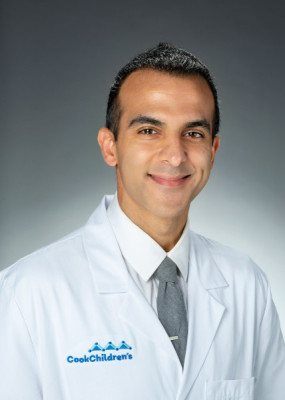
Amit Singh, M.D., on behalf of the Cook Children’s Experience Team
References/resources
1. Dyrbye LN, Shanafelt TD, Gill PR, Satele DV, West CP. Effect of a Professional Coaching Intervention on the Well-being and Distress of Physicians: A Pilot Randomized Clinical Trial. JAMA Intern Med. 2019 Oct 1;179(10):1406-1414. doi: 10.1001/jamainternmed.2019.2425. PMID: 31380892; PMCID: PMC6686971.
2. Kiser SB, Sterns JD, Lai PY, Horick NK, Palamara K. Physician Coaching by Professionally Trained Peers for Burnout and Well-Being: A Randomized Clinical Trial. JAMA Netw Open. 2024 Apr 1;7(4):e245645. doi: 10.1001/jamanetworkopen.2024.5645. PMID: 38607628; PMCID: PMC11015346.
3. Hoang K, Grow HM, Rooholamini SN, McPhillips H, Selling SK, Rassbach CE, Blankenburg R. Impact of Longitudinal Coaching on Pediatric Residents' Professional Identity Formation: A Multi-Institution Qualitative Study. Acad Pediatr. 2024 Jul;24(5):866-874. doi: 10.1016/j.acap.2024.04.012. Epub 2024 May 8. PMID: 38729301.
4. Selling SK, Rooholamini SN, Grow HM, McPhillips H, Hoang K, Blankenburg R, Rassbach C. The Effects of Coaching Pediatric Residents on Faculty Coaches' Relationships, Learning, and Professional Identity Formation. Acad Med. 2023 Mar 1;98(3):376-383. doi: 10.1097/ACM.0000000000005011. Epub 2022 Oct 4. PMID: 36205486.
5. https://www.ted.com/talks/atul_gawande_want_to_get_great_at_something_get_a_coach?subtitle=en