The Cook Children’s Experience Corner: Getting to Know Your Patients Beyond Their Illness
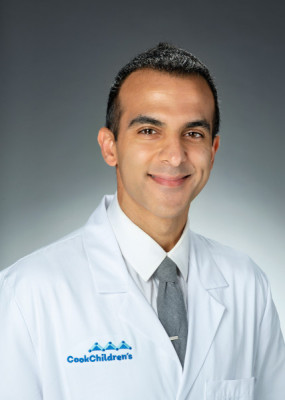
By Amit Singh, M.D., on behalf of the Cook Children’s Experience Team
 Depending on your specialty, most of us will have the opportunity to form lifelong relationships with our patients and families. However, there are many times when we meet them for the very first time during perhaps one of the most stressful times of their lives. It is our job to focus and lean into their illness. We are trained to charge forward to diagnose, manage, treat and educate. Often, taking the time to get to know our patients can get lost or seem irrelevant during those times. However, once the initial work is started, taking a moment to ask a question like, “I know we are seeing your child when they are ill and not feeling well but tell me, I’d love to know what they’re like when they don’t have to be sick. What brings your child joy? What makes them smile and laugh?” can really be a powerful tool for connection and treatment.
As a hospitalist, I am uniquely seeing patients when they are very sick and requiring hospitalization. In the midst of treating infections, working up unknown diagnoses, or trying to wean a patient off oxygen, I have found asking this question can really help create a little bit of calm in a sea of stress for families. Parents often really light up hearing their child talk about their favorite cartoon or favorite activity. It has given me an opportunity not only to learn more about the child I am taking care of, but also goes a long way to forming a therapeutic alliance with the family. With a question that takes maybe 10 seconds to ask and another 20 seconds to listen to the answer to, families are shown that we value their child as a human being. As a result of trying to asking this question more regularly, I have been fortunate to meet so many young authors, artists, competitive athletes and musicians. Their abilities often have me in awe of (and a little jealous of) their talents!
In some health systems, patient biographies are integrated directly into their care processes and health records for all to see. The My Life My Story project is an amazing example of how this can be formalized1,2. As part of this program, Veterans are interviewed about their life story and this interview is written up into a first person narrative. The Veteran then reviews it and, with their permission, it is entered into the healthcare record as a resource for the care team to know more about them a person, in their own words. What a wonderful opportunity to leverage our EMR to foster connection with our patients! Getting to know your patients in a structured and formal way isn’t just good bedside manner either. Studies have shown that not only does it go a long way to fostering compassionate care, but staff surveyed say that reviewing these narratives helped them provide better treatment or care, and helped them make more personalized decisions about the plan of treatment for their patients.
Pediatricians are particularly adept at longitudinal relationships given the length of time we are privileged to see our patients and families. If we can try to be intentional about asking our patients and families directly about what brings them joy, it can really go a long way in fostering relationship-centered care that demonstrates compassion and personalization.
Resources and References
- My Life, My Story | VA Boston Health Care | Veterans Affairs
- Lam JA, Feingold-Link M, Noguchi J, Quinn A, Chofay D, Cahill K, Rougas S. My Life, My Story: Integrating a Life Story Narrative Component Into Medical Student Curricula. MedEdPORTAL. 2022 Jan 26;18:11211.
- Nathan S, Woolley AB, Finlay L, Moye J. Teaching Pharmacy Students and Residents Patient-Centered Care Through Interviewing Veterans. Am J Pharm Educ. 2021 Sep;85(8):8384.
- Roberts TJ, Ringler T, Krahn D, Ahearn E. The My Life, My Story Program: Sustained Impact of Veterans' Personal Narratives on Healthcare Providers 5 Years After Implementation. Health Commun. 2021 Jun;36(7):829-836.